Breathing Exercises for Anxiety at Work: 5 Techniques You Can Do Discreetly
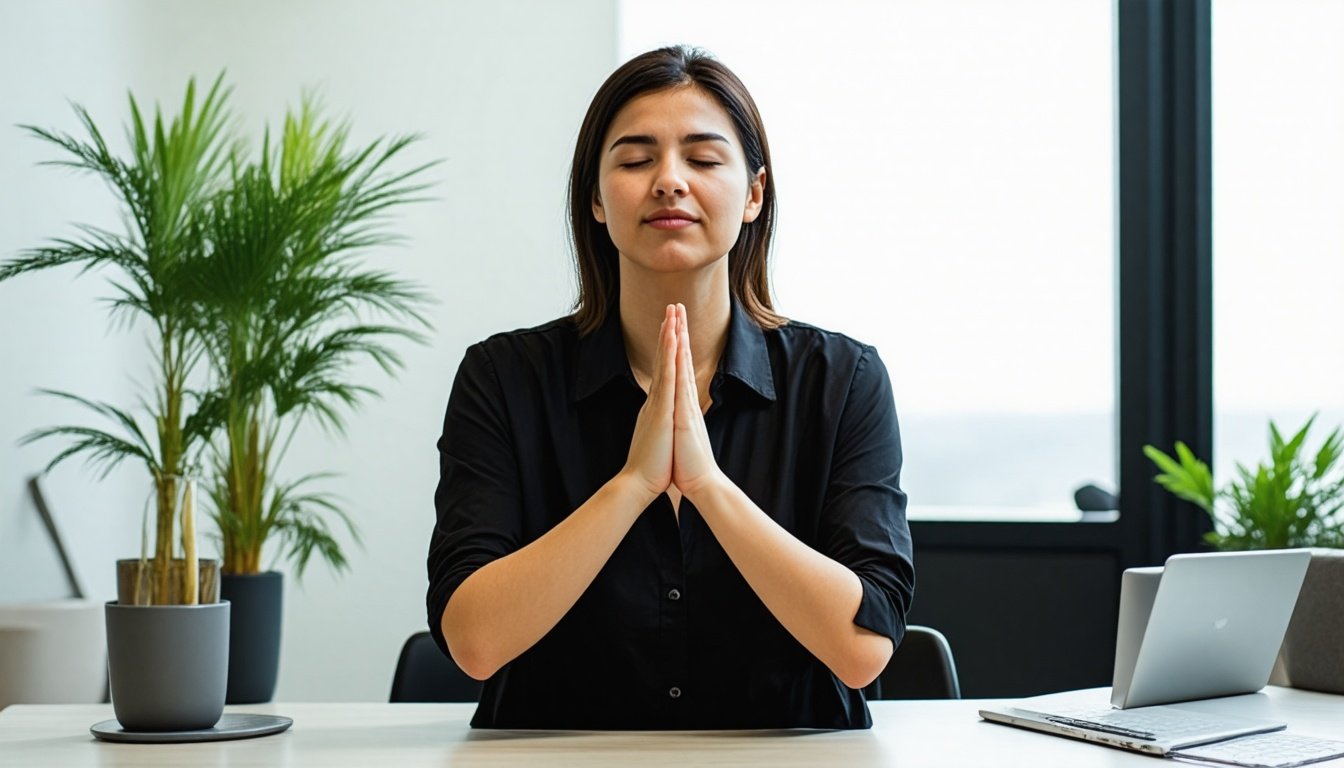
Free: 3-Minute Nervous System Reset
Get the audio guide and symptom checklist that shows you exactly how to calm your nervous system in under 3 minutes. Delivered straight to your inbox.
TL;DR
You can reset your nervous system at work without anyone noticing. Five breathing exercises reduce anxiety in under 5 minutes, and most are completely invisible to coworkers. The physiological sigh cuts stress in 30 seconds. Box breathing calms your nervous system in 2 minutes. Extended exhale breathing lowers your heart rate within 60 seconds. These techniques work by activating your vagal brake, which is the direct physiological connection between your breath and your parasympathetic nervous system. Practice one of them daily and your baseline anxiety level drops within 2 to 4 weeks.
You are in a meeting. Your heart is pounding. Your thoughts are racing. You can't leave, you can't explain what's happening, and you don't know what to do.
Most people white-knuckle through these moments. They don't know that the fastest anxiety reset available to you is already built into your body.
Your breath is the only part of your autonomic nervous system you can consciously control. Everything else, your heart rate, blood pressure, digestion, runs on autopilot. But because breathing is both voluntary and automatic, it gives you a direct lever on your stress response.
This guide covers five specific breathing techniques for workplace anxiety. Each one is practical. Most are invisible. All of them work.
Why Breathing Works for Work Anxiety
When anxiety hits at work, your sympathetic nervous system has taken control. Your breathing becomes shallow and fast. This reinforces the anxiety signal, telling your brain the threat is real.
Dr. Andrew Huberman, neuroscientist at Stanford University, puts it plainly: "The way you breathe directly controls your level of alertness and calmness. Extended exhales activate the parasympathetic nervous system and reduce stress in real time."
A 2024 report from the American Psychological Association found that 77% of adults experience physical symptoms from stress, with workplace pressure ranking as the top trigger. Breathing exercises address the physiological root of those symptoms directly.
The Vagal Brake Explained
Every time you exhale, your vagus nerve tells your heart to slow down. This is called the vagal brake. A longer exhale means more braking, which means a slower heart rate and a calmer nervous system.
Anxiety shortens your exhale. Every technique below lengthens it. That's the entire mechanism.
You don't need to understand the neuroscience to use these techniques. But knowing why they work helps you trust them when anxiety tells you nothing will help.
What Makes Workplace Breathing Different
Most breathing guides assume you're at home, alone, with 20 minutes to spare. Work is different. You need techniques that are fast, silent, and usable mid-conversation.
The five techniques below are ranked from fastest to slowest. Start at the top when you need immediate relief. Use the slower techniques for daily practice to reduce your baseline anxiety over time.
The 5 Breathing Exercises for Work Anxiety
Technique 1: The Physiological Sigh (30 seconds)
This is the fastest reset available. One cycle takes 15 to 20 seconds and looks like a natural sigh to anyone watching.
Here is how to do it:
- Take a full breath in through your nose
- At the top of that breath, take one more quick sniff in to fully expand your lungs
- Release a long, slow exhale through your mouth
Repeat two to three times.
Want a quick nervous system reset right now?
Get the free 3-minute audio guide and symptom checklist. Delivered instantly.
Research from Stanford published in Cell Reports Medicine (2023) found the physiological sigh was more effective than meditation for reducing acute stress. The double inhale fully expands the alveoli, the small air sacs that collapse during shallow breathing. The long exhale dumps carbon dioxide rapidly, which signals your nervous system that the threat has passed.
At your desk: This looks like a natural sigh. It is invisible.
Technique 2: Box Breathing (2 minutes)
Box breathing is used by Navy SEALs, surgeons, and emergency responders for high-pressure situations. It works by equalizing your inhale and exhale with two holds.
The sequence:
- Breathe in for 4 counts
- Hold for 4 counts
- Breathe out for 4 counts
- Hold for 4 counts
Repeat for 2 minutes, which is 8 to 10 cycles.
A 2024 study in Frontiers in Neuroscience found that 5 minutes of box breathing significantly reduced anxiety scores and cortisol levels in office workers during high-demand tasks. The equal ratio between inhale and exhale creates a balanced, regulated breathing pattern that neither over-activates nor under-activates your nervous system.
At your desk: Invisible when practiced at normal breathing depth. You can do it during a meeting, while reading emails, or before a difficult conversation.
For a detailed comparison of box breathing against other techniques, see our guide on box breathing vs 4-7-8 breathing for anxiety.
Three More Techniques for Different Situations
Technique 3: Extended Exhale Breathing (1 to 3 minutes)
This is the most flexible technique. All you do is make your exhale longer than your inhale.
Start with 4 counts in and 6 to 8 counts out. The exact ratio matters less than the principle. Your exhale should be at least 1.5 times longer than your inhale.
Dr. Richard Gevirtz, a leading researcher in heart rate variability biofeedback, has documented that exhale-dominant breathing reduces sympathetic nervous system activation faster than equal-ratio breathing. The vagal brake activates with each exhale, and a longer exhale means more sustained activation of your parasympathetic system.
At your desk: Completely silent. You can extend your exhale during any normal breathing moment without changing your posture or expression.
Technique 4: Coherent Breathing (5 minutes, best for ongoing stress)
Coherent breathing means breathing at exactly 5.5 seconds in and 5.5 seconds out, which puts you at about 5 to 6 breaths per minute. This rate maximally synchronizes your heart rate variability with your breath, producing the strongest parasympathetic activation of any technique.
Most people breathe 12 to 20 times per minute. Slowing to 5 to 6 requires practice but produces lasting change.
Research published in the International Journal of Psychophysiology (2024) found that 5 minutes of coherent breathing increased heart rate variability by 38% and reduced cortisol by 15% in adults with chronic workplace stress. Workers who practiced daily for 4 weeks reported 42% lower anxiety scores compared to a control group.
At your desk: Best during low-demand tasks like reading or writing, rather than active conversation. This one builds your regulation capacity over time rather than providing immediate relief.
For more on how heart rate variability connects to stress resilience, see our guide to HRV tracking for beginners.
Want a quick nervous system reset right now?
Get the free 3-minute audio guide and symptom checklist. Delivered instantly.
Technique 5: 4-7-8 Breathing (for pre-meeting nerves)
The 4-7-8 technique extends the hold before the exhale, which deepens the relaxation response. It is particularly useful before high-stakes situations: presentations, performance reviews, difficult conversations.
The sequence:
- Breathe in for 4 counts
- Hold for 7 counts
- Exhale slowly for 8 counts
Repeat 4 cycles.
The 7-count hold allows a slight buildup of carbon dioxide. When you release on the 8-count exhale, the vagal brake activates strongly. Many people notice a visible drop in heart rate and muscle tension after just 2 cycles.
At your desk: Slightly audible on the exhale. Best used in a private moment before entering a meeting room or during a bathroom break.
When to Use Each Technique
Different situations call for different techniques. Here is a quick reference.
Mid-meeting anxiety spike: Use the physiological sigh. It takes 30 seconds and is invisible.
Racing thoughts while working: Use box breathing. Two minutes of 4-4-4-4 breathing resets your focus and calms your nervous system.
Ongoing background tension throughout the day: Use extended exhale breathing. Simply lengthen every exhale and your tension gradually releases over the hours.
Before a big presentation or difficult conversation: Use 4-7-8 breathing in a private space. Four cycles takes under 2 minutes.
Building long-term resilience to work stress: Use coherent breathing daily. Five minutes each morning lowers your baseline anxiety over weeks.
The fastest techniques address acute anxiety in the moment. The slower techniques build nervous system resilience so fewer moments require emergency relief.
For more techniques you can use without leaving your desk, see our guide to nervous system reset exercises at your desk.
Building a Simple Workplace Breathing Routine
One practice per day is enough to change your baseline anxiety level within 2 to 4 weeks. You do not need a special room, a meditation cushion, or a dedicated time block.
A simple three-point routine:
- Before you open your laptop: 5 minutes of coherent breathing (5.5 seconds in, 5.5 seconds out)
- When stress builds mid-morning: 2 minutes of box breathing at your desk
- Before any high-stakes moment: 3 physiological sighs in the hallway or bathroom
Total time: under 10 minutes across the whole day.
A 2025 review in the Journal of Occupational Health found workers who practiced daily breathing exercises for 4 weeks reported 42% lower anxiety scores than a control group. They also reported higher job satisfaction and fewer physical stress symptoms.
The key variable is consistency, not duration. Daily 5-minute practices create more change than weekly hour-long sessions.
If breathing exercises alone are not enough during severe anxiety episodes, combining them with grounding techniques increases effectiveness. See our guide to grounding techniques for anxiety for a practical combination.
For a complete guide to calming anxiety quickly in any situation, see how to calm down fast when anxiety hits.
Your First Step Right Now
Pick one technique. Try it now. Notice what happens to your heart rate and the quality of your thoughts over the next 2 minutes.
Start with the physiological sigh. Take a full breath in through your nose. Sniff in a little more. Then release a long, slow exhale. Do that twice.
That is your starting point.
For a free guided audio that walks you through the full 3-minute nervous system reset, including a step-by-step voice guide you can follow at your desk, download the free reset below.
Download the free 3 Minute Nervous System Reset guide here
Your next anxious moment at work is coming. You now have five ways to handle it that work in 30 seconds or less, most of them without anyone knowing you did anything at all.
Frequently Asked Questions
Do breathing exercises really work for anxiety at work?
Yes. Breathing exercises produce measurable physiological changes within seconds. Extending your exhale activates the vagus nerve, which directly lowers heart rate and cortisol. Multiple peer-reviewed studies confirm the effect. A 2024 Stanford study found the physiological sigh more effective than meditation for acute stress reduction. The techniques work because they use a real pathway: your breath directly modulates your autonomic nervous system. They are not a distraction or a placebo.
How quickly do breathing exercises reduce anxiety?
The physiological sigh produces noticeable effects within 30 seconds. Box breathing and extended exhale techniques typically reduce anxiety within 1 to 2 minutes. Coherent breathing takes 5 minutes to produce its full effect. Most people notice a measurable drop in heart rate and mental tension within the first minute of any technique. The fastest results come from techniques with the longest exhale relative to inhale.
Can I do breathing exercises during a meeting without anyone noticing?
Yes. The physiological sigh looks like a natural sigh. Box breathing and extended exhale breathing are invisible at normal breathing depth. The physiological sigh is the most practical for active meetings because it takes 30 seconds and produces immediate results. Avoid 4-7-8 breathing during meetings as the exhale can be audible. If you practice box breathing regularly, it becomes automatic and requires no visible behavior change.
How often should I practice breathing exercises for work anxiety?
Daily practice produces the best results. Even 5 minutes per day of coherent breathing or box breathing reduces baseline anxiety within 2 to 4 weeks. Use acute techniques like the physiological sigh as needed throughout the day. Daily practice changes how your nervous system responds to stress over time, not just in the moment. People who practice twice daily (morning and mid-day) see results faster than those who only practice when anxious.
What is the fastest breathing exercise for anxiety at work?
The physiological sigh is the fastest. One cycle takes 15 to 20 seconds and produces a measurable reduction in anxiety. The technique involves a full inhale, a second quick sniff to fully expand the lungs, and one long exhale. Research from Stanford found it reduces stress more rapidly than any other single breathing technique tested. Two to three cycles are typically sufficient for acute anxiety relief.
Can breathing exercises help with anxiety at work long term?
Yes, and this is where they are most powerful. Daily breathing practice gradually lowers your baseline cortisol levels, increases heart rate variability, and trains your nervous system to respond to stress with less intensity. After 4 to 6 weeks of consistent practice, most people report fewer anxiety spikes throughout the day, faster recovery when stress does occur, and a general reduction in the physical symptoms of workplace stress. See our full guide to resetting your nervous system in 5 minutes for a broader daily routine.
About Diego Pauel
Diego is a certified breathwork facilitator, freediving instructor, and founder of Breathflow Connection. With years of experience in nervous system regulation and somatic practices, Diego helps stressed professionals find calm through simple, science-backed techniques.
Learn More →Try Our Free Interactive Tools
Start regulating your nervous system today.
Get the free 3-minute audio guide and symptom checklist. Delivered instantly.
Get Your Free ResetContinue reading
Freeze Response vs Shutdown: Understanding Your Dorsal Vagal State
Learn the difference between the freeze response and dorsal vagal shutdown. How each feels in your body and practices to
Read More →
Heart Racing from Anxiety? 6 Techniques to Slow It Down in Minutes
Heart racing from anxiety? Learn 6 science-backed techniques to slow your heart rate in minutes. Understand why it happe
Read More →
HRV Tracking for Beginners: What Your Heart Rate Variability Tells You About Stress
Learn how to track heart rate variability to measure stress and nervous system health. Beginner friendly guide to unders
Read More →