How to Stop an Anxiety Spiral: 5 Steps to Break the Loop Before It Takes Over

Free: 3-Minute Nervous System Reset
Get the audio guide and symptom checklist that shows you exactly how to calm your nervous system in under 3 minutes. Delivered straight to your inbox.
TL;DR
An anxiety spiral is a self-reinforcing loop where anxious thoughts trigger physical symptoms, and those symptoms confirm the fearful thoughts. The loop feeds itself and accelerates. You can break it at three points: the thought layer, the physical layer, and the environmental layer. The fastest physical interrupts are the physiological sigh (15 to 30 seconds) and cold water on the face (under 60 seconds). This guide gives you 5 steps in order, from immediate interrupt to full recovery, so you know exactly what to do the moment you feel a spiral starting.
You notice one anxious thought. Then another follows. Your chest tightens slightly. That tightness makes you more anxious. The anxiety makes your thoughts race faster. The racing thoughts make your chest tighter.
Within minutes, what started as a single worry has become a full spiral. You cannot think clearly. Your body feels like it is bracing for something terrible. Every attempt to reason your way out seems to make it worse.
This is an anxiety spiral, and it affects roughly 40 million adults in the United States. Understanding why the loop works the way it does is the first step to breaking it.
Why Anxiety Spirals Are So Hard to Stop with Thinking
Most people try to stop an anxiety spiral by arguing with the anxious thoughts. They tell themselves "this is not a big deal" or "I am overreacting." It rarely works. Here is why.
An anxiety spiral is not primarily a thinking problem. It is a nervous system state. When your fight or flight response activates, it shifts blood flow away from your prefrontal cortex (the part of your brain responsible for rational thinking) and toward your amygdala (the threat detection center).
So while you are trying to use logical reasoning to calm down, you are trying to use the very system that has just gone partially offline. Your prefrontal cortex has less blood and less oxygen. It is genuinely harder to think clearly, not because you lack willpower, but because the anxiety response has temporarily reduced your capacity for rational thought.
Dr. Lisa Feldman Barrett, neuroscientist and author of "How Emotions Are Made," explains: "Your brain is not wired to perceive and then feel. It is wired to predict and then perceive. Once your brain has predicted danger, it takes physical evidence to update that prediction."
Physical evidence. Not logical argument. That is why the fastest interventions for anxiety spirals target your body first, and your thoughts second.
The Three Layers of an Anxiety Spiral
Every spiral has three reinforcing layers:
- Thought layer: Catastrophic predictions, worst case scenarios, "what if" chains that build on each other
- Physical layer: Tight chest, shallow breathing, racing heart, muscle tension, tingling hands
- Behavioral layer: Checking, avoiding, seeking reassurance, ruminating, freezing
The loop runs between these layers continuously. Anxious thoughts create physical sensations. Physical sensations confirm the threat is real. Confirmation accelerates the thoughts. Behavioral responses (checking your phone, avoiding the situation) prevent your nervous system from learning that the threat was not real.
You can break the loop at any layer, but the physical layer is the fastest entry point because it bypasses the cognitive override problem.
5 Steps to Stop an Anxiety Spiral
Use these steps in order. Each one builds on the previous. Steps 1 and 2 are the immediate interrupt. Steps 3 through 5 complete the recovery.
Step 1: Name the Spiral Out Loud
The moment you notice the loop starting, say out loud: "This is an anxiety spiral. My nervous system is activating. This will pass."
This is not reassurance or positive thinking. It is a specific neurological technique called affect labeling, and it has measurable physical effects.
A 2007 study from UCLA found that putting feelings into words reduced activity in the amygdala and increased activity in the right ventrolateral prefrontal cortex. Labeling the emotional experience creates a small but measurable interruption in the automatic threat response. The activation does not disappear, but it decreases enough to give you access to the next steps.
Want a quick nervous system reset right now?
Get the free 3-minute audio guide and symptom checklist. Delivered instantly.
Say it out loud because speaking engages different neural pathways than thinking. The act of producing speech requires your prefrontal cortex, which creates a tiny window of cognitive function in a moment when that function is compromised.
Step 2: Break the Physical Loop with Breathing
Once you have named the spiral, interrupt the physical layer immediately. You have two options depending on what is available to you.
Option A: The physiological sigh
Take two quick inhales through your nose (one stacked immediately on top of the other), then one long exhale through your mouth. Make the exhale at least twice as long as the combined inhales.
Repeat 3 to 5 times.
A 2023 Stanford study published in Cell Reports Medicine found that cyclic sighing was the most effective of four breathwork interventions tested, outperforming mindfulness meditation and box breathing for immediate reduction of physiological stress markers. The double inhale fully inflates the lung alveoli, and the extended exhale sends a direct signal through the vagus nerve to downregulate the autonomic nervous system.
Option B: Cold water on the face
If breathing is difficult (some people find that focusing on breath during a spiral increases anxiety), splash cold water on your forehead, cheeks, and the area around your eyes. Or press a cold pack against your face for 15 to 30 seconds.
This activates the mammalian dive reflex, an involuntary parasympathetic response that drops heart rate by 10% to 30% within seconds. Unlike breathing, you cannot think your way out of the dive reflex. It activates automatically regardless of your mental state.
For a detailed comparison of breathing techniques, see our guide to box breathing versus 4 7 8 breathing.
Step 3: Ground Yourself in the Present Environment
After using a physical interrupt, your nervous system needs confirmation that no actual threat exists. Grounding provides that confirmation through sensory input.
Use the 5 4 3 2 1 method: name out loud 5 things you can see, 4 things you can touch right now, 3 things you can hear, 2 things you can smell, and 1 thing you can taste.
Move through this slowly. Touch the objects you name. Do not rush.
This works because anxiety spirals keep your attention locked on internal sensations and future predictions. Grounding forces your attention outward to present sensory reality. Your nervous system reads this as: "The threat detection system is scanning for danger and finding a safe, stable environment." That reading reduces the alarm.
A 2025 study found that the 5 4 3 2 1 method reduced the percentage of participants reporting high anxiety from 23% to 4%. For 10 more grounding options, see our full guide on grounding techniques for anxiety.
Want a quick nervous system reset right now?
Get the free 3-minute audio guide and symptom checklist. Delivered instantly.
Step 4: Change Your Physical Environment
Move to a different location. If you are inside, step outside. If you are sitting, stand and walk. If you are in a crowded space, find a quieter one.
This step works at the environmental level of the spiral. Your nervous system uses context cues to maintain threat predictions. The environment where the spiral started becomes associated with the anxious state. Changing your physical location removes those context cues and gives your nervous system a fresh sensory input to evaluate.
This is not avoidance. Avoidance means leaving because you believe the situation is actually dangerous and never returning. A brief environmental change as a recovery strategy is different. You are using the environment as a tool, not running from a perceived threat.
Even walking to another room, opening a window, or stepping onto a balcony for 2 minutes provides enough environmental shift to reduce the spiral.
Step 5: Discharge the Physical Activation
Your body has cortisol and adrenaline circulating from the spiral. These stress hormones do not disappear on their own quickly. Physical movement metabolizes them faster than sitting and waiting.
Walk for 5 to 10 minutes at a brisk pace. Shake your hands loosely. Do 10 jumping jacks. Stretch your shoulders and neck. Any moderate physical activity that engages your large muscle groups will work.
Research published in the Journal of Clinical Psychiatry shows that even a 10 minute walk reduces cortisol levels and activates endorphin production. The mechanism is simple: your body released cortisol and adrenaline to prepare for physical action. Physical action is the natural completion of that cycle.
After movement, your nervous system can return to baseline faster. Without movement, those hormones continue circulating and make it harder for the spiral to fully resolve.
What Makes Anxiety Spirals Worse
Certain responses feel helpful in the moment but extend the spiral.
Reassurance Seeking
Texting a friend for reassurance, Googling your symptoms, or asking others to confirm you are okay provides momentary relief but reinforces the anxiety loop. Each time you seek reassurance, you teach your nervous system that the situation required checking, which increases its assessment of the threat level.
Use the 5 steps above instead of seeking reassurance during a spiral. Reserve talking to others for after the spiral has passed.
Trying to Suppress the Thoughts
Thought suppression ("stop thinking about it") consistently backfires. A classic psychology experiment by Daniel Wegner found that instructing people not to think of a white bear caused them to think about it more frequently than a control group. Suppression increases the psychological salience of the unwanted thought.
Instead of suppressing anxious thoughts, use step 1 to label them and then redirect your attention outward with grounding (step 3). You are not fighting the thoughts. You are simply putting your attention elsewhere.
Caffeine During or After a Spiral
Caffeine blocks adenosine receptors, which prevents the natural calming signal from reaching your brain. During a spiral, your nervous system is already running hot. Caffeine extends that state. If you feel a spiral coming on or have just come through one, skip caffeine for the rest of the day.
Preventing Spirals Before They Start
Stopping a spiral in the moment is first aid. Preventing spirals requires building a daily regulation practice that keeps your baseline arousal level low enough that small triggers do not cascade.
Consistent practice of breathwork or body-based techniques for even 5 minutes per day measurably lowers your resting threat response. Your amygdala becomes less reactive. Small stressors are less likely to activate the spiral loop.
Research on nervous system regulation shows that daily practice changes the physical structure of the prefrontal cortex over time. The connection between the prefrontal cortex and amygdala strengthens, which improves top-down regulation of the threat response.
For where to begin with this practice, see our guide on nervous system regulation for beginners.
Know Your Spiral Triggers
Most anxiety spirals have consistent triggers: certain times of day, social situations, work contexts, or physical states like hunger, fatigue, or caffeine overload. Keeping a brief daily log for two to three weeks often reveals clear patterns.
Once you know your high-risk windows, you can apply preventive techniques before entering them. Five minutes of the physiological sigh before a high-stakes meeting, for example, reduces baseline activation before the trigger even occurs.
If your spirals escalate to full panic attacks, see our guide on how to stop a panic attack fast.
A Note from Diego
The anxiety spiral was something I dealt with for years before I understood what was actually happening in my body. I would catch myself in the loop and immediately try to think my way out. It never worked. I just got more frustrated on top of being anxious.
What changed everything was learning that the spiral is not a thought problem. It is a nervous system state. Once I understood that, I stopped arguing with my thoughts and started working with my body. The physiological sigh became automatic within a few weeks of daily practice. Now I catch spirals much earlier and interrupt them before they build.
The fastest way to build this skill is to practice when you are calm, not only when you are anxious. Try our free 3 minute nervous system reset today, while you are reading this. Doing it once when you feel fine helps your body learn the pattern so it is available when you need it.
If you want a structured daily practice that builds real spiral resilience over time, the 7 Day Nervous System Reset gives you a different technique each day and guides you through building the habits that prevent spirals from taking hold.
Frequently Asked Questions
How long does an anxiety spiral typically last?
Without intervention, anxiety spirals typically last 20 to 45 minutes before the body exhausts its adrenaline reserves and begins to come down naturally. With active intervention using the 5 steps above, most spirals can be interrupted within 5 to 10 minutes. The key variable is how quickly you apply a physical interrupt. The longer a spiral runs before you intervene, the more cortisol has accumulated and the longer full recovery takes. Early intervention is significantly more effective than waiting for the spiral to peak.
Why do anxiety spirals seem to happen out of nowhere?
Most spirals that feel random have identifiable triggers your conscious mind does not register. Your nervous system processes environmental information below the level of conscious awareness through a process called neuroception. A tone of voice, a body sensation, a smell, or a subtle social cue can activate the threat response before you are aware of any trigger. Keeping a brief daily log noting your state before and after spirals typically reveals consistent patterns within two to four weeks. Sleep deprivation, caffeine, low blood sugar, and high-stress periods all lower the threshold at which these sub-threshold triggers activate the spiral.
Is an anxiety spiral the same as a panic attack?
They are related but different. An anxiety spiral is a building process where thoughts and physical sensations reinforce each other over minutes. A panic attack is the peak intensity state, characterized by sudden, severe physical symptoms including heart pounding, chest tightness, shortness of breath, and a sense of impending doom. Many panic attacks begin as anxiety spirals that were not interrupted early. Not all anxiety spirals become panic attacks. The 5 steps in this guide are most effective when applied early in the spiral process. If you experience full panic attacks regularly, see our guide on how to stop a panic attack fast for techniques specific to that intensity level.
Can anxiety spirals cause physical symptoms?
Yes, and this is one of the reasons they are self-reinforcing. When your nervous system activates the stress response, it triggers real, measurable physical changes: heart rate increases, breathing becomes shallow, muscles tense, digestion slows, and circulation shifts. These physical symptoms are genuine, not imagined. They then become new data points your nervous system uses to confirm the threat assessment, which intensifies the spiral. Recognizing that physical symptoms are a product of the nervous system response (not evidence of an underlying physical illness) is important for interrupting the confirmation loop. If you regularly experience physical symptoms during anxiety and are concerned about underlying health conditions, see a doctor to rule out non-anxiety causes.
Why does breathing help with anxiety spirals?
Breathing is the only autonomic function you can consciously control. Your heart rate, digestion, and blood pressure are automatic. But because breathing is both voluntary and automatic, it creates a direct bridge between your conscious mind and your autonomic nervous system. When you slow your breathing rate and extend your exhale, you send a signal through the vagus nerve that activates the parasympathetic system, the system responsible for rest and recovery. This is not metaphorical. The vagus nerve physically connects your brainstem to your heart, lungs, and digestive system, and breathing patterns directly modulate its activity. For a detailed guide to the most effective techniques, see our post on vagus nerve exercises for anxiety.
How do I stop an anxiety spiral at work when I cannot do breathing exercises openly?
Several techniques work discreetly in professional settings. Box breathing (4 counts in, 4 hold, 4 out, 4 hold) is invisible when practiced at normal breathing depth. The physiological sigh can be done as a quiet, natural-looking deep breath. The 5 4 3 2 1 grounding technique works entirely in your head without any visible behavior. If you have 2 minutes, step outside or to a bathroom for the cold water technique. For a full guide to techniques designed specifically for work environments, see our post on nervous system reset exercises you can do at your desk.
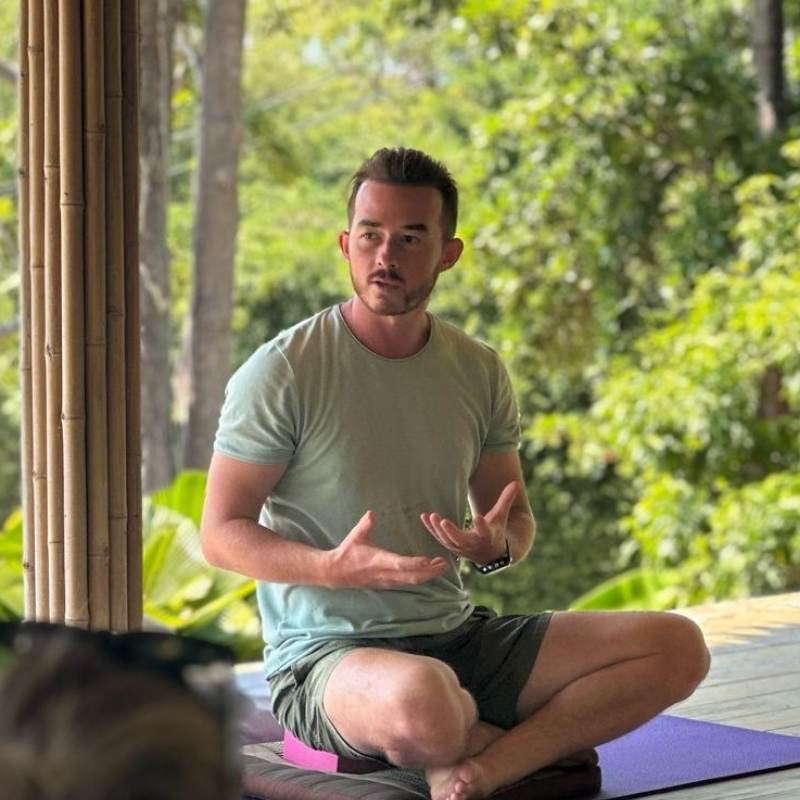
About Diego Pauel
Diego is a certified breathwork facilitator, freediving instructor, and founder of Breathflow Connection. With years of experience in nervous system regulation and somatic practices, Diego helps stressed professionals find calm through simple, science-backed techniques.
Learn More →Try Our Free Interactive Tools
Start regulating your nervous system today.
Get the free 3-minute audio guide and symptom checklist. Delivered instantly.
Get Your Free ResetContinue reading

Vagus Nerve Exercises for Anxiety: 10 Beginner Friendly Techniques
Learn 10 simple vagus nerve exercises that reduce anxiety fast. Beginner friendly techniques you can do anywhere. Scienc
Read More →
How Long Does It Take to Regulate Your Nervous System? (Timeline Guide)
Discover the realistic timeline for nervous system regulation. Week by week breakdown of what to expect from breathwork
Read More →
Nervous System Regulation for Beginners: Where to Start When Everything Feels Overwhelming
Learn nervous system regulation for beginners. Where to start, what to do first, and how to build a simple daily practic
Read More →